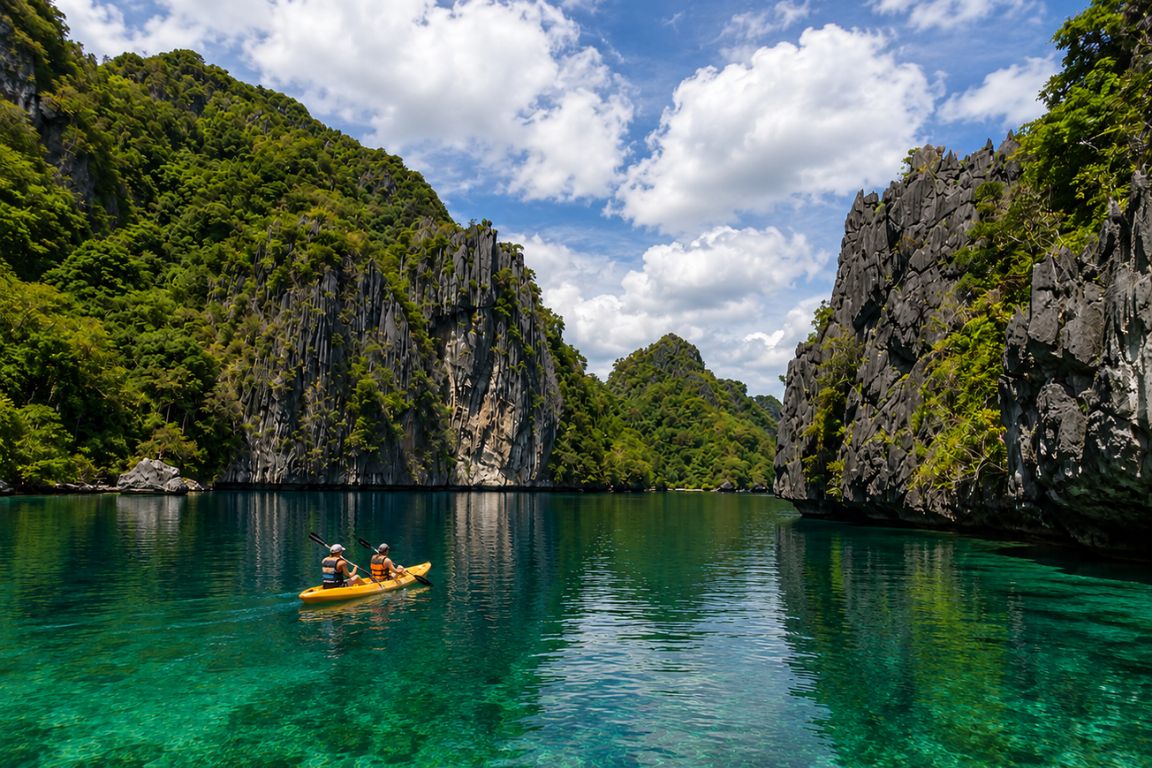
El Nido Tour C Guide
Tour C is the most adventurous and best snorkeling-focused island hopping route in El Nido, taking travelers to remote outer islands, hidden beaches, and dramatic limestone coastlines.
Keep the guide’s route advice in mind, then compare the exact shared and private options after the complete article and answers. Compare Your El Nido Options Below.
Last updated: July 29, 2026
Tour C is the outer island route of El Nido’s four standard tours, covering Helicopter Island, Secret Beach, Hidden Beach, Matinloc Shrine, and Tapiutan Island. It travels further from town than Tours A, B, or D, runs 9am to roughly 5pm, and consistently ranks as the favorite tour among travelers who do multiple routes. The best snorkeling of any standard tour is here, particularly around the Matinloc wall. Secret Beach’s swim-through entry is the most physically dramatic stop in the entire archipelago. Group tours cost PHP 1,200 to 1,400 per person. Matinloc Shrine charges an optional PHP 200 entrance fee on site.
| Stops | Helicopter Island, Secret Beach, Hidden Beach, Matinloc Shrine, Tapiutan Island (Talisay Beach) |
| Duration | 9am to approx. 5pm (longer than Tours A and B due to distance) |
| Group tour price | PHP 1,200 to 1,400 per person - Prices verified June 2026 |
| Private boat price | PHP 7,000 to 9,000 total - Prices verified June 2026 |
| ETDF (eco fee) | PHP 400 one-time, valid 10 days - Prices verified June 2026 |
| Matinloc Shrine entrance | PHP 200 per person (optional, paid on site) - Prices verified June 2026 |
| Lagoon fees | None - Tour C has no lagoon stops |
| What’s included | Bangka boat, licensed guide, life vest, grilled seafood lunch, snorkel gear (basic) |
| Snorkeling quality | Best of the four standard tours, particularly Matinloc wall and Tapiutan reef |
| Best for | Snorkelers, adventurous swimmers, anyone who’s done Tour A and wants a second day on the water |
- Tour C focuses on Helicopter Island and hidden beaches across a full outer-island day.
- Choose between a shared boat and a private boat for your party.
- Confirm water-entry suitability, current shrine charges and return timing before booking.
What Is El Nido Tour C?
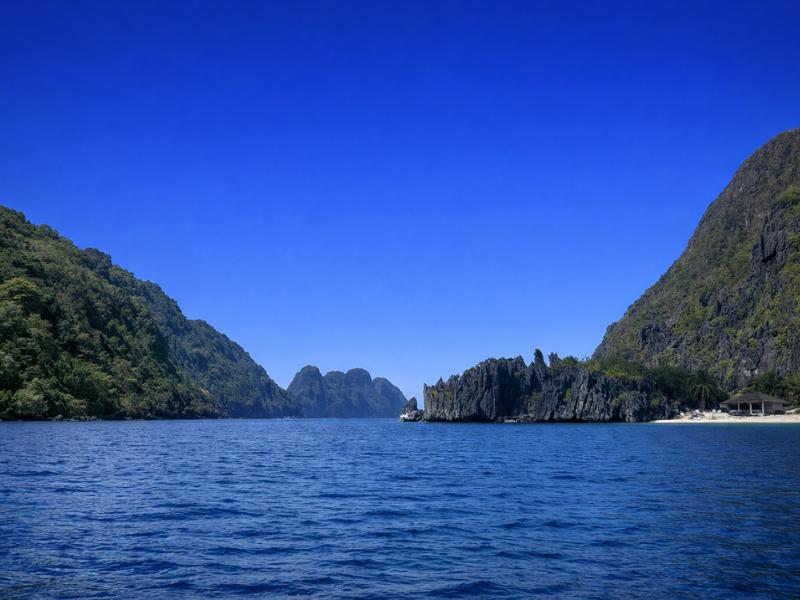
Tour C is the outer island route, taking travelers further from El Nido town than any other standard tour and delivering the archipelago’s most dramatic beach access experiences. It covers Helicopter Island, Secret Beach, Hidden Beach, Matinloc Shrine, and Tapiutan Island across a full day that runs longer than Tours A and B due to the distances involved. Tour C consistently ranks as the favorite tour among travelers who do multiple routes in El Nido, and it carries the best snorkeling conditions of the four standard options.
Every island hopping tour in El Nido promises something extraordinary, and most of them deliver. Tour C delivers differently. Where Tour A‘s Big Lagoon is about enclosed grandeur and Tour B‘s Snake Island is about tidal spectacle, Tour C asks you to earn its highlights physically. Secret Beach requires swimming through a rock passage. Hidden Beach requires navigating through a crevice in the cliff. The Matinloc Shrine viewpoint requires climbing steep limestone steps in the heat. The tour doesn’t hand you its best moments: you swim to them.
All four El Nido tours look similar on paper but cover completely different ground - our Tour A vs B vs C vs D guide breaks down exactly what each route includes and which one suits different types of travellers.
That character shapes the day. Travelers who arrive on Tour C expecting a passive boat trip through beautiful scenery often find themselves more engaged and more tired than they expected. Travelers who arrive ready to move through the water tend to leave saying Tour C was the best day of their El Nido trip.
The distance from town also means Tour C is the tour most affected by weather. The outer islands sit exposed to the South China Sea’s swell in wet season, and the coastguard is quicker to restrict Tour C than any other route when conditions deteriorate. Boat departures and individual stops remain subject to conditions in every season.
Wondering whether the dry season crowds are worth it over a quieter shoulder season visit where the weather is still mostly reliable? This best time to visit El Nido tours guide covers the seasonal trade-offs most Palawan travel blogs oversimplify.
We have been running this route since 2014, and more than 60 percent of our travelers who do multiple tours rate Tour C as their favorite. If you want to plan the day around arriving at Secret Beach before the other boats, start with the private Tour C listing, or the group Tour C if a fixed schedule is enough.
What Are The Stops On Tour C?
Tour C covers five main stops: Helicopter Island (long beach, strong snorkeling, named for its aerial silhouette), Secret Beach (swim-through entry to an enclosed white sand cove on Matinloc Island), Hidden Beach (narrower crevice entry, enclosed cove), Matinloc Shrine (abandoned clifftop chapel with panoramic views, optional PHP 200 entry), and Tapiutan Island/Talisay Beach (lunch stop, excellent snorkeling, starfish in the shallows). The route sequence varies by guide and conditions.
The sequence matters more on Tour C than on any other route. Secret Beach, the tour’s most dramatic stop, has no capacity regulation equivalent to the Big Lagoon’s entry limits. But practically speaking, arriving when two or three other group tour boats are already anchored off the cliff changes the experience significantly. The swim-through passage becomes a queue. The enclosed beach inside fills with 40 people. The atmosphere that makes it memorable, the silence and the enclosed limestone walls, disappears under noise and bodies.
A well-run Tour C sequence opens at Helicopter Island or Tapiutan while other boats head straight for Secret Beach, then reverses back to Secret Beach mid-morning when the first wave of tours has moved on. This is guide knowledge rather than policy, and it’s exactly the kind of timing management that makes a meaningful difference to the day.
Here is how a well-sequenced Tour C typically runs:
- 8:00 to 8:30am: Meet at the operator’s office near El Nido pier. Boat departs.
- ~9:30am: Helicopter Island or Tapiutan Island first, while other boats converge on Secret Beach.
- ~10:30 to 11:00am: Secret Beach. Swim from the anchored boat to the cliff entrance. Guide assists through the passage.
- ~11:30am: Hidden Beach. A shorter stop, different character from Secret Beach.
- ~12:00pm: Talisay Beach (Tapiutan Island). Lunch on the beach. Snorkeling off the point.
- ~2:00 to 2:30pm: Matinloc Shrine. Optional stop (PHP 200 entry). Viewpoint climb.
- ~3:30 to 4:00pm: Final beach stop or snorkel site before return.
- ~5:00pm: Back at El Nido pier. Tour C returns later than the others.
Return time genuinely runs to 5pm or beyond on some days. Plan your Tour C evening accordingly.
What Is Helicopter Island Like?
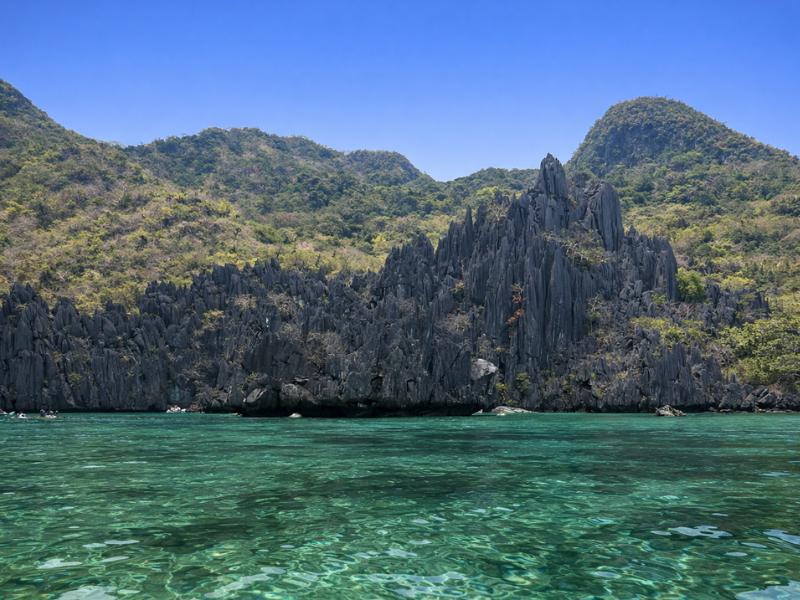
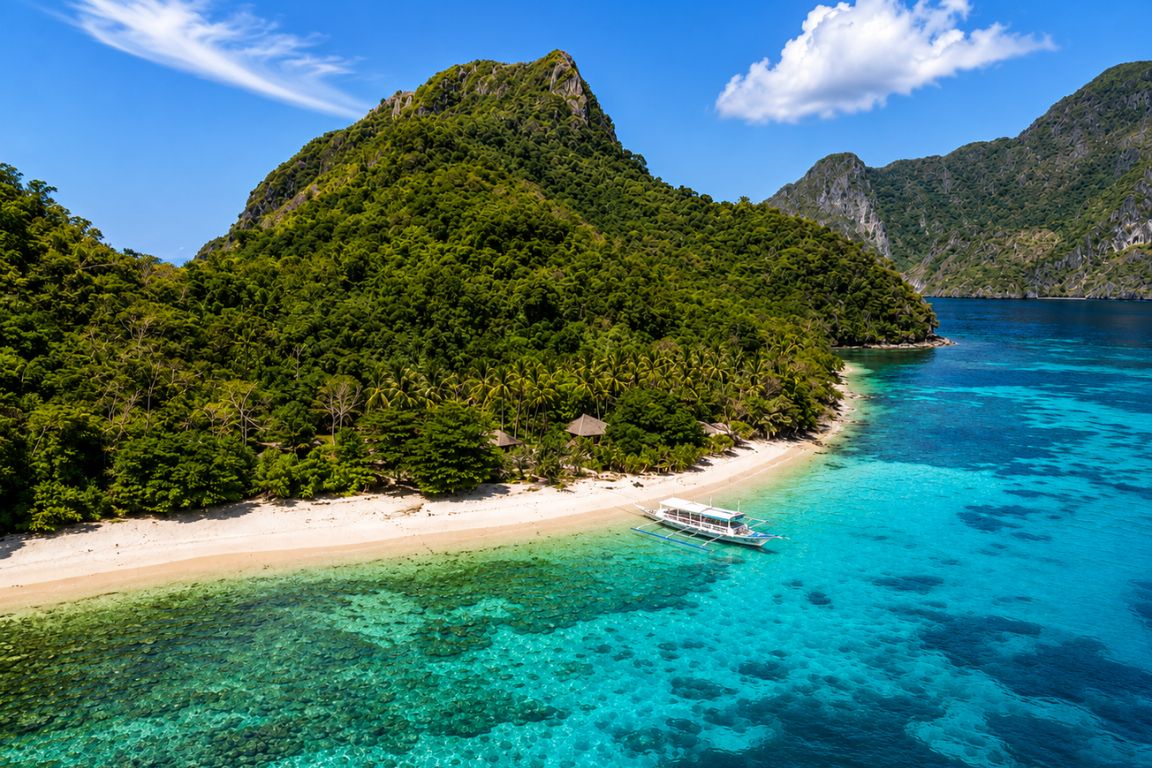
Helicopter Island, officially Dilumacad Island, is named for the aerial silhouette of its limestone cliffs and vegetation, which resembles a rotary aircraft when viewed from above. On the ground it is a long, sandy beach with rock formations at the far end, warm shallow water, and a snorkeling reef offshore that is consistently strong. It is one of the more spacious beaches on any standard tour route, with room to spread out even when multiple boats are present.
The name is the first thing that confuses visitors. Arriving by boat at sea level, the helicopter shape isn’t obvious. You need altitude to see it, which is why drone footage of Tour C always includes this island. What you do see from the water is a long pale beach backed by dense green jungle and high limestone, with a rocky point at the far end where the snorkeling concentrates.
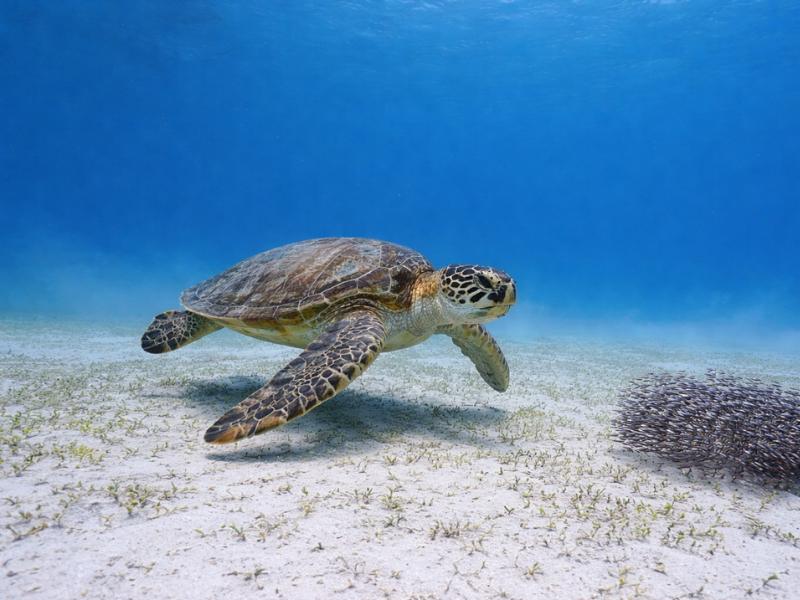
The snorkeling at Helicopter Island is genuinely strong. The reef runs close to the shoreline and the water stays clear enough that visibility is good even without much effort. Sea turtle sightings here are common, particularly around the rocky point at the beach’s southern end where seagrass patches attract feeding greens. Bring your own mask if you have one; the rental gear provided on group tours works but a well-fitting mask makes a real difference to the experience.
Helicopter Island is typically either the opening stop or the closing stop of Tour C, and it works well in either position. As an opening stop, it eases the group into the water before the more physically demanding stops later in the day. As a closing stop, it lets the day finish on a long, uncrowded beach with a beer and a view while the boat crew packs up. Either way, most travelers spend 45 to 60 minutes here.
What Is Secret Beach Like?
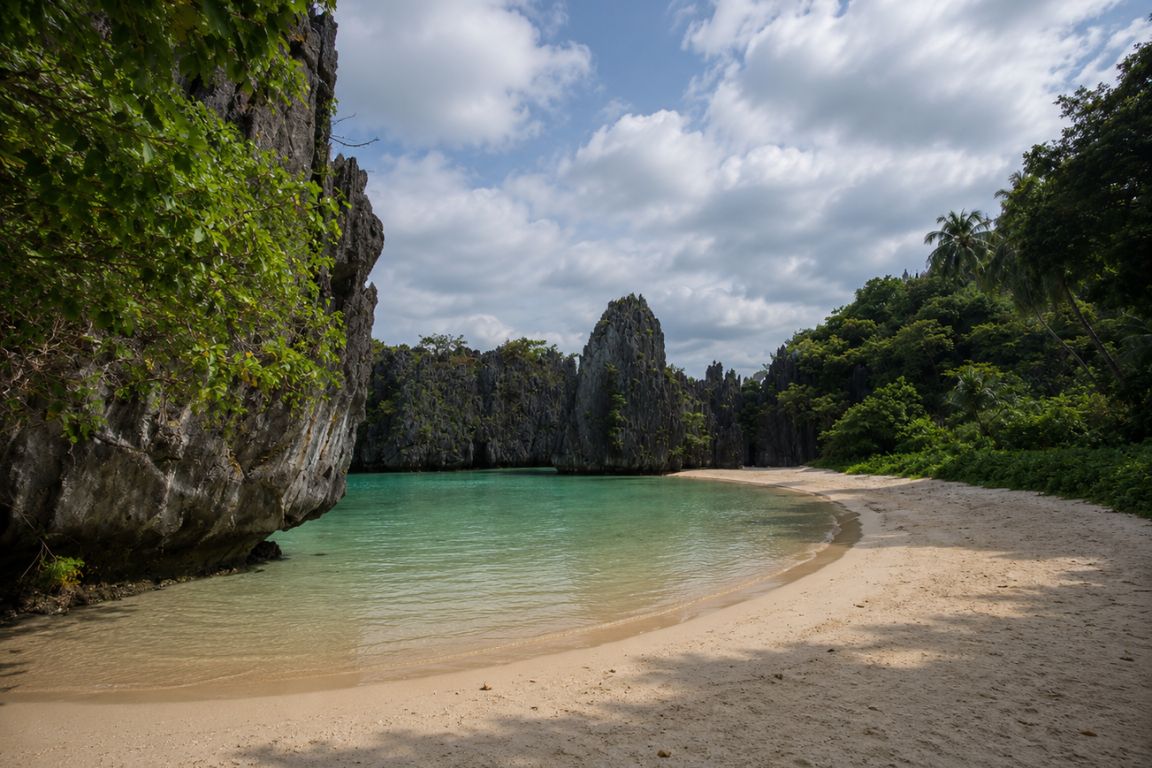 Secret Beach is an enclosed white sand cove on Matinloc Island, completely invisible from the open sea and accessible only by swimming through a narrow underwater passage in the limestone cliff face. The passage is roughly one to two metres wide. At low tide you can wade through with your head above water. At high tide you must briefly submerge for one to two seconds to duck under the rock arch. Inside, vertical limestone walls rise 30 to 50 metres on all sides around a crescent of pale sand and emerald water. It is the most physically dramatic stop in the Bacuit Archipelago.
The approach to Secret Beach is designed to mislead. Your boat anchors off a cliff wall that reads as a dead end. There is no visible opening from the water, at least not at first. The guide points. Your eyes find it: a gap in the rock that looks too narrow, too low, too unlikely to lead anywhere worth going. And then you swim toward it.
The distance from the boat to the entrance is 30 to 50 metres of open water swimming. At low tide you arrive at the gap and find you can push through mostly upright, ducking your head under the rock for a moment as you pass. At high tide the gap sits lower in the water and you have to commit: one or two seconds of full submersion, one strong pull, and you emerge on the other side.
Inside, the sound changes first. The ocean chop and boat noise drop away entirely. The enclosed walls create a stillness that has no equivalent on any beach you can walk to. The water is a shade of turquoise that only makes sense inside a space like this, lit from above through the open sky between the cliffs. The sand is white and fine. There are no vendors, no structures, no shade beyond what the walls themselves provide at certain angles of light.
The experience is entirely different depending on how many people are inside when you arrive. With five people, the place is genuinely overwhelming. With 40 people spread across the sand and bobbing in the water, it becomes a crowded beach. This is the strongest argument for a private tour with early departure on Tour C, or for a guide who sequences the route to hit Secret Beach in the window between the first wave of boats and the mid-morning rush.
One practical note: Secret Beach is the one stop on Tour C where non-swimmers face a genuine limitation. Life vests are provided and required, but the swim-through itself requires a degree of water confidence that a life vest alone can’t fully substitute for. Non-swimmers should tell their guide before the day begins. Experienced guides will assist at the passage entrance and can judge whether conditions are safe for a specific person to attempt the entry.
What Is Hidden Beach Like?
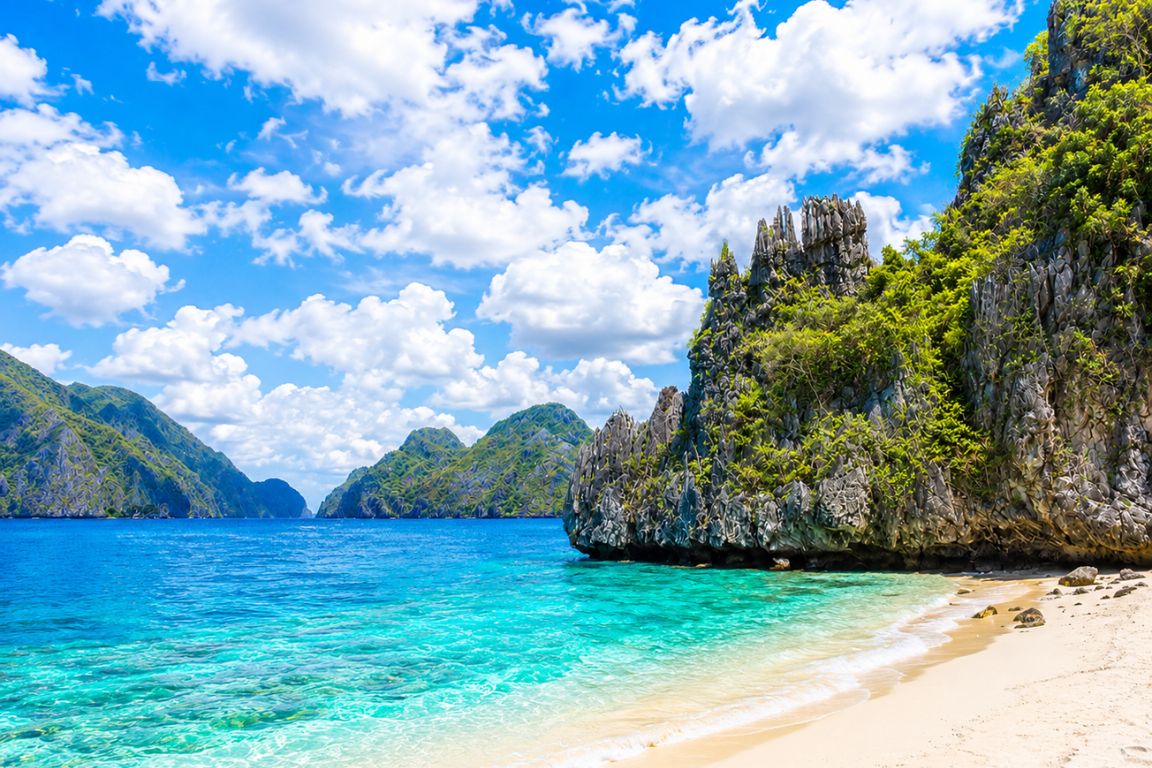 Hidden Beach is a second enclosed cove on Matinloc Island, smaller than Secret Beach and accessed by swimming around a large limestone rock barrier rather than through it. The swimming area inside forms a natural pool with calm, clear water and limestone walls. It is less physically dramatic to enter than Secret Beach but rewards travelers with a genuinely tranquil space. The name is accurate: the beach is entirely invisible from the passing boat.
Hidden Beach and Secret Beach are often confused because they share an island and a similar concept: a beach concealed behind limestone, only accessible by water. The practical experience is quite different. Hidden Beach doesn’t require a submerged swim-through. You swim around a large rock formation that acts as a natural gate, round the corner, and arrive at the cove. More accessible physically, but it feels slightly less earned than Secret Beach.
Inside, the water is extraordinarily clear and the scale is intimate. The space is smaller than Secret Beach and the walls feel closer. Sunlight reaches the water at different angles depending on the time of day, which affects the color. Earlier in the day, the water inside reads a deeper blue. Later in the afternoon, it shifts toward turquoise as the light angle changes. Tour C guides who know this sequence their Hidden Beach stop accordingly.
The swimming area functions like a natural infinity pool. The floor is sandy where it’s shallow and the water gets deeper as you move toward the center. There is a point where you float in the middle of this enclosed space with limestone on all sides and open sky above and very little else. That moment, unremarkable to describe, tends to stay with travelers in the way that big dramatic vistas don’t.
What Is Matinloc Shrine Like?
Matinloc Shrine is an abandoned cliffside chapel on Matinloc Island, built by a devout local family in the 1980s and left unfinished when construction stopped abruptly. The roofless structure sits on a limestone shelf above a small white beach, surrounded by jungle and overlooking the Bacuit Archipelago. A short but steep climb leads to a viewpoint with panoramic 360-degree views across the outer islands. The shrine charges a PHP 200 optional entry fee. The stop is brief, 20 to 30 minutes, but the viewpoint is one of the best vantage points on any island hopping tour.
From the boat, you see a white statue of Jesus Christ on the shoreline first, then the chapel building above it on the cliff, partially obscured by vegetation. The construction began in the 1980s as an act of private religious devotion and stopped without clear explanation. Local accounts attribute the abandonment to financial difficulties. Others say the family felt the spiritual purpose had been completed. The Philippine government later designated Matinloc Island as part of the protected Bacuit Bay Marine Reserve, ending any possibility of resuming construction.
The result is a ruin that doesn’t look ruined: the walls are intact, the structure is complete in outline, but roofless and slowly being reclaimed by the surrounding plants. The atmosphere it creates is not quite sacred and not quite haunted, though local guides invariably have a ghost story to tell about the island. Ask yours. The story varies by telling and none of them are verifiable, which makes them better.
The viewpoint climb takes 10 to 15 minutes up concrete steps cut into the limestone, steep and uneven in the upper section. Flip-flops are a genuine mistake here. At the top, the Bacuit Archipelago spreads in every direction: Tapiutan Strait below, the outer island chain to the south, El Nido town visible in the distance to the northeast. On a clear dry season morning this is one of the most compelling views accessible on any standard island hopping tour in the Philippines.
The PHP 200 entry fee is optional in the sense that the stop itself is on the tour itinerary but entering the shrine and climbing to the viewpoint is a personal choice. Most travelers pay it. The viewpoint alone justifies it. A small handful of travelers skip the shrine and stay on the beach for snorkeling, which is also worth doing: the reef near the shoreline here hosts sea turtles with enough regularity that guide commentary at this stop often includes turtle sighting instructions before anyone gets in the water.
How Do You Book Tour C And What Does It Cost?
Group Tour C costs PHP 1,200 to 1,400 per person and can be booked through tour operators in El Nido town, at your accommodation, or through platforms like Klook and GetYourGuide. The ETDF eco fee (PHP 400) is paid separately. Matinloc Shrine charges an optional PHP 200 on site. There are no lagoon fees on Tour C. Private boat hire runs PHP 7,000 to 9,000 total. Because Tour C travels further and runs longer than other tours, it benefits more from private booking for timing flexibility, particularly around Secret Beach.
Compare the full current quotes for Tour A and Tour C, including the environmental charge and any site fees or rentals. Different inclusions can change the comparison, so a fixed price difference between route letters is not a reliable booking rule.
| Group tour (per person) | PHP 1,200 to 1,400 | Varies by operator; longer day than Tour A |
| ETDF (eco fee) | PHP 400 | One-time, valid 10 days, all tours |
| Matinloc Shrine entrance | PHP 200 | Optional; paid on site; worth it for viewpoint |
| Snorkel mask rental | PHP 100 to 150 | Optional; bring your own for better fit and experience |
| Water shoes rental | PHP 50 to 100 | Recommended for Matinloc Shrine climb and rock entry points |
| Private boat (total) | PHP 7,000 to 9,000 | For the whole boat; timing flexibility especially valuable on Tour C |
All prices verified June 2026 against El Nido Municipal Tourism Office records and operator price lists.
If having your own boat matters on Tour C, compare the private option and ask how the operator can sequence the stops. Secret Beach remains a shared natural site, and a private ticket cannot guarantee entry before other visitors.
For groups of four or more, the per-person cost of a private Tour C boat approaches the group rate and buys genuine control over the day’s most important stop. Dates and group size for that option are on the private Tour C page.
Not sure whether a private El Nido tour justifies the premium over a standard group island-hopping boat? Check out our private El Nido tours guide before you decide either way.
What Should You Know Before Doing Tour C?
The most important things to know before Tour C: bring your own snorkel mask (the Matinloc wall is Tour C‘s best stop and deserves a well-fitting mask), pay the Matinloc Shrine entry fee (the viewpoint earns it), wear water shoes for the shrine climb, and go on Tour C after Tour A, not before. Tour C is the tour most travelers rate highest in retrospect, but its impact is strongest when Tour A has already set the baseline.
A few things from years of running this route that don’t appear in the typical pre-trip research:
The Matinloc snorkeling wall is the hidden best stop on Tour C. Most travelers arrive expecting Secret Beach to be the tour’s peak and everything else to be supporting. The snorkeling off the Matinloc shoreline, particularly the reef wall that drops to about 15 metres along the western face of the island, is consistently the strongest underwater experience on any standard tour. Sea turtles are common here, feeding in the seagrass that lines the base of the reef. The soft coral at depth is in good condition. Most group tours allocate snorkel time at this stop and it’s where you should spend it rather than rushing back to the beach early.
Palilo Beach is the Tour C secret that most boats miss. Adjacent to the Matinloc Shrine snorkel zone, a small unnamed beach (sometimes called Palilo Beach) sits around the point from where the boats anchor. It sees almost no traffic because it isn’t on the official itinerary. On a private tour, asking the guide to stop here for 20 minutes gives you a private beach experience in the middle of Tour C‘s busiest segment. On a group tour, swimming toward the point during the snorkel stop and climbing out onto this beach gives the same result if the guide gives you the space to do it.
Motion sickness matters more on Tour C. The outer islands sit further from the sheltered inner bay, and the boat transit on Tour C runs across more exposed water than Tours A, B, or D. In any conditions with chop, the bangka ride to and from Helicopter Island and the Matinloc stretch can be rough. If you experience motion sickness, ask a pharmacist or clinician about a suitable option and follow its directions. Consider the boat conditions and your own comfort before choosing the route.
The Matinloc Shrine climb requires real footwear. Not hiking boots, but not flip-flops either. The steps cut into the limestone are steep, uneven, and occasionally slippery with morning moisture. Closed-toe water shoes or light trainers work. The climb is 10 to 15 minutes and the footing is the only genuinely uncomfortable part of the day if you’re wearing the right shoes.
Want to know what El Nido’s most popular island-hopping route actually covers before you commit to a full day on the water? Here’s our El Nido Tour A guide so you arrive knowing what to expect.
Tour C Insights From Our 8,200+ Guided Travelers
| Travelers who rated Tour C as their favorite El Nido tour | 61% (among those who did multiple tours) |
| Most cited highlight of Tour C | Secret Beach entry experience (58%), Matinloc Shrine viewpoint (24%) |
| Travelers who paid Matinloc Shrine entry fee | 87% |
| Most common preparation mistake | No water shoes for shrine climb (43%), insufficient cash for extras (31%) |
| Travelers who experienced motion discomfort on Tour C transit | 14% (highest of any standard tour) |
| Average return time to pier | 5:10pm (latest of the four tours) |
| Travelers who said Tour C exceeded Tour A | 61% who did both |
Frequently Asked Questions
Is Tour C or Tour A better?
Most travelers who do both rate Tour C higher by the end of their trip. Tour A is the right first tour because it covers El Nido’s most iconic sites and sets the reference point for the archipelago. Tour C is often more memorable precisely because it’s more physically engaging, travels further, and delivers stops like Secret Beach that earn their impact. Do Tour A first, Tour C second, and expect to prefer Tour C.
Can non-swimmers do Tour C?
Yes, with caveats. Life vests are provided for all passengers and are required on the boat. Most Tour C stops are accessible with a life vest. Secret Beach, however, requires a degree of water confidence to navigate the swim-through passage safely. Non-swimmers should tell their guide at the start of the day. A good guide will assess conditions and assist, and at low tide the entry is significantly more manageable. Hidden Beach is more accessible for non-swimmers as the entry swims around rather than through rock.
What is the Matinloc Shrine entry fee and is it worth it?
The Matinloc Shrine charges PHP 200 per person, paid on site and optional. It is worth paying. The viewpoint climb delivers one of the best panoramic views accessible on any standard island hopping tour, and the abandoned chapel itself has an atmosphere unlike any other stop in El Nido. The snorkeling near the shrine is also excellent and is free regardless of whether you pay the entry fee.
Why does Tour C take longer than other tours?
Tour C travels further from El Nido town than Tours A, B, or D. The outer islands, particularly Matinloc Island and Tapiutan Island, sit toward the southern end of the Bacuit Archipelago. The additional transit time, combined with five stops including the time-consuming shrine climb, means Tour C regularly returns to the pier around 5pm compared to 4pm for Tour A. Plan your Tour C evening around this.
What is the best stop on Tour C?
Secret Beach has the most impact on most travelers. The swim-through entry to an enclosed cove that’s invisible from the open sea produces a moment that people consistently describe as one of the most memorable of their El Nido trip. The Matinloc wall snorkeling is the strongest underwater experience. The Matinloc Shrine viewpoint is the best panorama. All three are legitimate candidates for best stop depending on what the individual traveler values.
Does Tour C have lagoon entry fees?
Tour C does not include the lagoon stops listed for Tours A and D, but environmental and site charges or equipment rentals can still apply. The verified group listing currently shows a Matinloc charge different from this guide’s older estimate. Compare the current option’s complete quote rather than assuming C is cheaper.
Ready to book Tour C?Group Tour C and private Tour C both run Helicopter Island, Secret Beach, Hidden Beach, Matinloc Shrine, and Tapiutan. Written by Ethan Reyes
Philippine tour guide since 2014 · Founder, El Nido Tours
Ethan has guided over 8,200 travelers through El Nido, the Bacuit Archipelago, and Palawan since founding the agency.